Rowhouse Chimneys, Party Walls and the Neighbor Who Builds Higher
In a city where most homes share a wall, chimneys get shared too: stacks that straddle the party line, flues serving two houses, and additions next door that leave your chimney too short. We inspect every flue in the stack for free and document both sides.
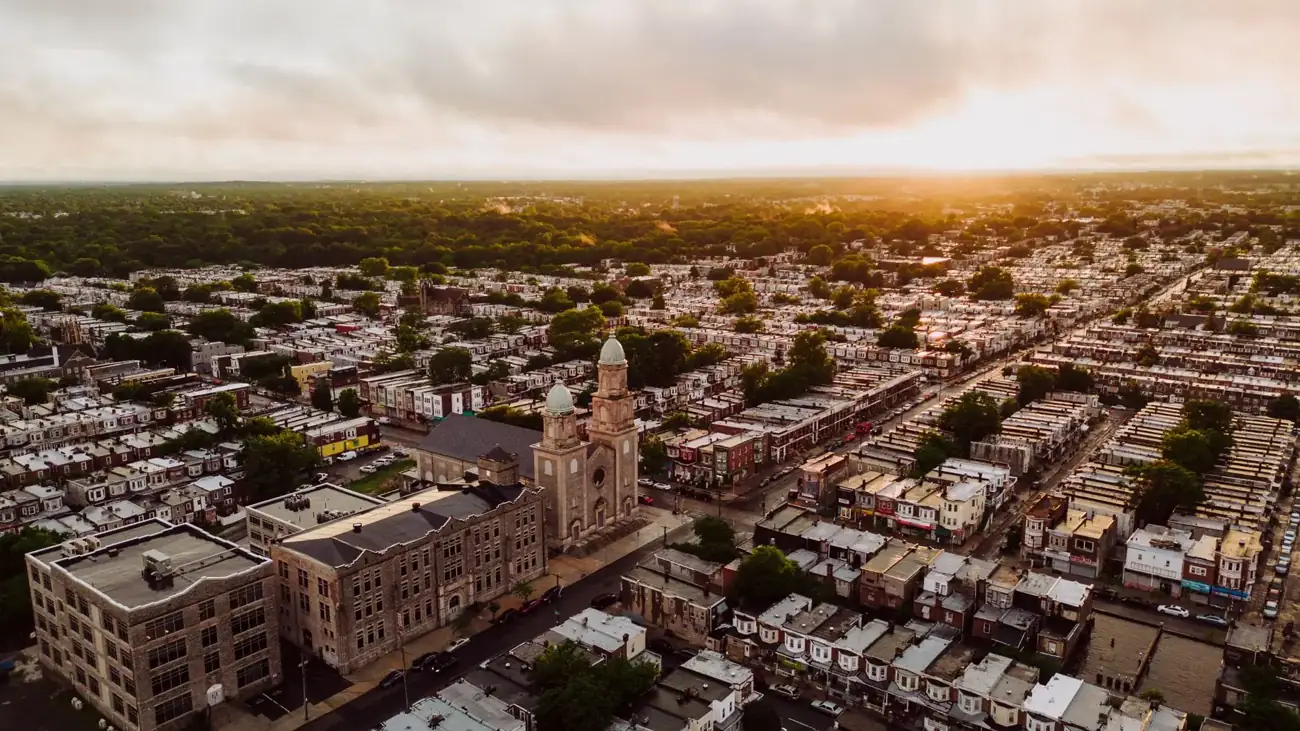
About 56% of Philadelphia homes are rowhouses, twins or townhouses, by the Census Bureau's 2024 count of one-unit attached houses. Nationally the figure is about 6%. Norristown (47%), Reading (52%) and Lancaster city (52%) are attached-house towns too. Between 1887 and 1892 alone, the City's Philadelphia Rowhouse Manual notes, nearly 45,000 houses went up in Philadelphia, most of them rowhouses built against brick party walls.
That history explains most of what we find on rowhouse roofs: chimneys built into or against the party wall, stacks holding flues for two houses, coal-era flues now venting gas furnaces and water heaters, and soft brick laid in very thin joints. It also explains the newest trouble. As blocks gain third floors and roof decks, chimneys that were tall enough for a century are suddenly too short, and the exhaust they carry has somewhere new to go.
When to call
- The house next door added a floor or roof deck and now rises above your chimney
- You received an L&I 'Notice of Required Chimney or Vent Modification'
- Smoke, fumes or a CO alarm after construction next door
- Your chimney shares a stack with the neighbor's and only one of you keeps it up
- Mortar washing out of the party-wall stack, or loose bricks at the top
- A gas technician shut off an appliance because of venting
The visit, step by step
- Free inspection, both sides of the lineWe check every flue in the stack, note which house and appliance each one serves, and photograph your side and, with permission, the neighbor's.
- Clearance checkWe measure your chimney against the roof and anything within 10 feet, including new construction next door.
- Written scope and priceRepairs priced in writing. An extension needed because a neighbor built higher is priced at the inspection.
- Permits and paperworkWe check what L&I requires for the job, including the separate mechanical permit you authorize for an extension.
When the neighbor builds higher: Regulation B-3307.1, step by step
Philadelphia has a written rule for this, Regulation B-3307.1, and an L&I information sheet, P_062_INF, that explains it. It applies when a new or altered building will rise above the roofline of the house next door, and that house has a chimney or vent within 10 feet. It covers permit applications filed on or after January 1, 2024. Here is how it runs.
The notice. At least 60 days before work starts, the builder must mail you written notice on L&I's form, to the address the Office of Property Assessment has on file. The notice describes the work and its effect on your chimney or vent, and offers to secure the permits and fund or perform the extension. It must also warn you that if you decline or do not respond, you may be held responsible. If you don't answer, a final notice follows at least 10 days before work begins.
Your permit. The extension needs its own mechanical permit, and the regulation says that permit is authorized by you, the owner of the chimney. Under L&I's EZ standard for one- and two-family houses three stories or less, it is taken out for your property. The builder must show compliance before the new building rises above your roof, and the permit for your chimney must be signed off before their final inspection. L&I's sheet says enforcement action will be taken if they go above your roof first.
If you say no, or say nothing. The regulation then makes you responsible for keeping your existing equipment venting safely, and the builder is released. The 60-day wait can also be waived if you agree, or if you reject the offer outright. So read the notice, and answer it, even if only to ask questions.
Defects that were already there. Problems your chimney had before the extension are yours to fix, not the builder's. If a Pennsylvania professional engineer says the extension cannot be done safely until they are corrected, you have 60 days from notice to correct them.
Two exceptions let the builder skip the extension: your chimney no longer serves a fireplace or appliance, or a Pennsylvania architect or engineer certifies it already meets code. If something goes wrong with construction next door, call 311, or 215-686-8686 from outside Philadelphia.
What happens when nobody extends the chimney
L&I's own training slides put the risk bluntly: building higher than a neighbor's chimney obstructs airflow and leads to increased fire risk, potential carbon monoxide poisoning and appliances that run poorly. Exhaust that once cleared the roof now hits a wall and drifts back down, sometimes into the house it came from and sometimes into the neighbor's windows.
Community Legal Services' Rowhouse Protection Project report, published in June 2026, describes a Graduate Hospital client whose neighbor built a third-floor addition in 2023. In 2024, PGW found elevated carbon monoxide at her furnace and shut off her gas. A chimney contractor then found her chimney had been sealed over with plywood and black tar, with debris inside and damaged brick, and that no extension had ever been built. CLS won her a $4,600 judgment in May 2026. The project serves households at or below 60% of area median income and can be reached at 215-981-3700.
If a CO alarm is sounding, or PGW has shut off an appliance after work next door, get the chimney looked at before anything is relit. Our photos, roof to basement, are the record you will want for the builder, L&I or a lawyer.
Shared stacks: who owns the chimney?
No Philadelphia rule we have found says who owns or pays for a stack shared by two rowhouses. The neighbor-builds-higher regulation covers only that one situation. For a shared stack, the answer depends on which flue serves which house and on what your deeds say, and sometimes on an agreement between neighbors.
What we can do is make the facts clear. At the inspection we trace each flue to the house and appliance it serves, photograph both sides of the stack where we have access, and write up the condition of each flue and of the shared masonry. Two neighbors working from the same photos find it far easier to settle who does what.
Some flues in shared stacks are in poor shape inside, and people in the trade here have raised the worry that a cracked liner can let exhaust drift between flues in the same stack. Current code wants a minimum of 4 inches of masonry separating flues in the same chimney, and it bars venting another appliance through the gap around a liner. We check for both.
Old brick, butter joints and what the repair looks like
The Philadelphia Rowhouse Manual, published by the City in 2008, describes the very thin mortar joints on many nineteenth-century rowhouses as butter joints and says the old mortar must be removed by hand, not sawn out into a wider joint. It also says new mortar needs properties similar to the brick, and that Philadelphia brick has a durable outer face over a much softer interior. Grind a joint wider or chip the face, and water reaches the soft core.
Rowhouse chimneys get a pointing mix matched to the brick in color and kept weaker than it, the approach the Park Service's repointing brief lays out. Repointing the stack typically runs $500 to $2,500. When the top courses are loose or the brick is too far gone, taking it down to the roofline and relaying it is usually a $1,000 to $3,500 job. When a neighbor's addition forces an extension, we price it at the visit; the cost turns on the new height and what the flue carries.
In Philadelphia, pointing often needs no permit unless the property is on the historic register. Extensions and appliance work do need permits, and a historic building needs Historical Commission approval before an extension. We check what L&I requires for your job before work starts.
Answers
Rowhouse & Party-Wall Chimneys questions
The house next door is adding a third floor. What does the builder have to do about my chimney?
If your chimney or vent is within 10 feet and their building will rise above your roof, Regulation B-3307.1 requires them to send written notice at least 60 days ahead and offer to secure permits and fund or perform the extension. The extension gets its own mechanical permit, which you authorize.
I got a notice about my chimney. What happens if I ignore it?
Then the responsibility moves to you. Under the regulation, if you reject the offer or don't respond, you must make sure your equipment still vents safely, and the builder is released from that duty. Answer the notice, even if only with questions.
My chimney had cracks before the addition. Who fixes those?
You do. The regulation says defects that existed before the extension are the owner's responsibility. If an engineer says the extension can't be done safely until they are fixed, you have 60 days from notice.
PGW shut off my gas after the neighbor's construction. What now?
Don't relight anything until the venting is fixed. Have the chimney inspected and photographed, call 311 to report the construction problem, and if your household income qualifies, Community Legal Services' Rowhouse Protection Project may be able to help at 215-981-3700.
Who pays to fix a chimney shared with my neighbor?
No city rule settles it. It depends on which flue serves which house and on your deeds. We document both sides, flue by flue, so the two of you can decide from the same facts.
Same family of jobs
Brick, stone, water and rebuilding

Schedule
Choose a morning or an afternoon.
Sunday through Friday, arrival between 8 and 11, 11 and 2, or 2 and 5. The look costs nothing, and a person phones you the day before.