Chimney and Fireplace Service in Reading
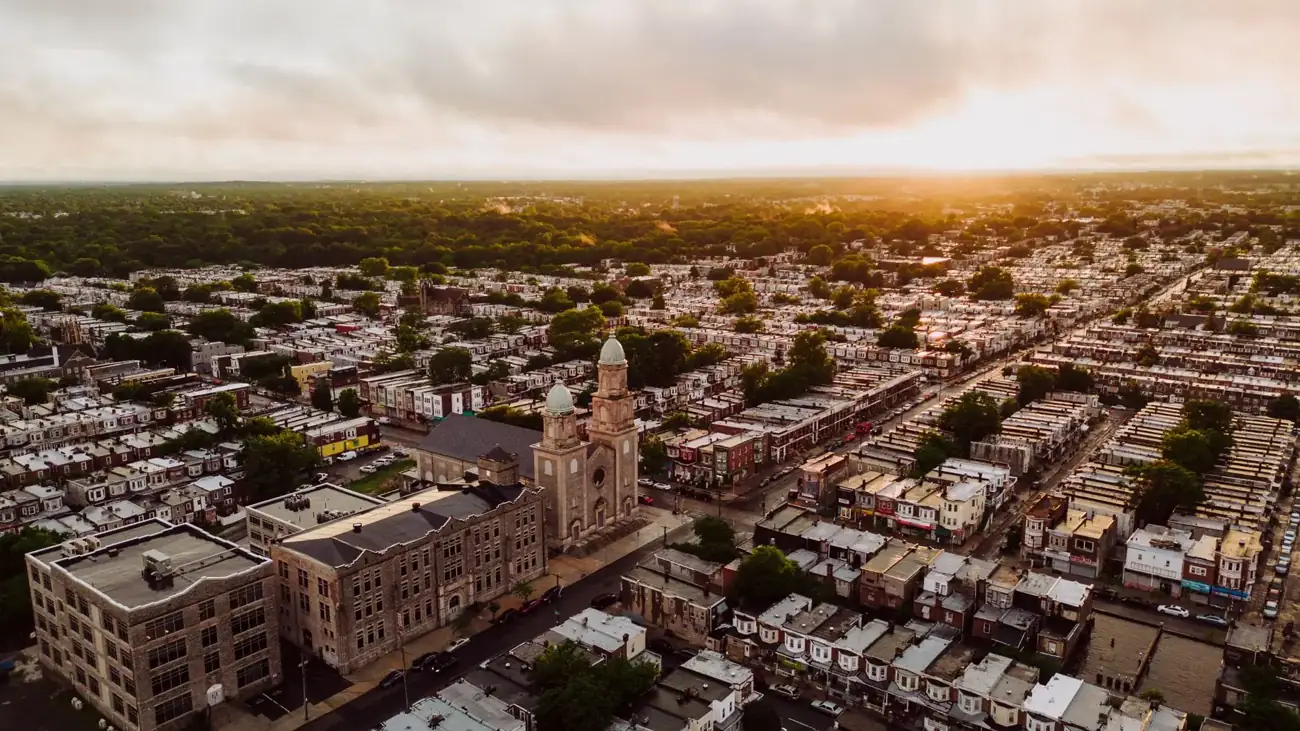
Between the Schuylkill and Mount Penn, Reading is a city of rowhouses: more than half its homes are attached, and more than half were built before 1940. We look at it for free.
Reading was laid out in 1748 and is the seat of Berks County. Wikipedia describes a city bounded by the Schuylkill River on the west, Mount Penn on the east and Neversink Mountain on the south, with the Japanese-style Pagoda built on Mount Penn in 1908 looking down over it. The 2020 census counted 95,112 residents. Centre Park, Callowhill, Prince, Penn's Common, Hampden Heights, Southside and Oakbrook are among its neighborhoods, and we work in all of them, plus West Reading, Wyomissing and the boroughs around the city.
The housing numbers explain the work. Census figures (ACS 2024) put 56.9 percent of Reading's homes before 1940, a higher share than in Philadelphia, and 52.2 percent are attached, meaning rowhouses, twins and townhouses. Next door, West Reading is older still, at 58.9 percent pre-1940 and 61.4 percent attached. Utility gas heats 54.1 percent of Reading homes and fuel oil 14 percent. Across Berks County, oil heats 21.3 percent of homes, about six times the national share, and roughly 4,300 Berks homes heat mainly with wood.
Rowhouse chimneys and party walls
In a Reading rowhouse, the chimney can rise from the party wall, and one stack can hold flues from two houses. Nothing in state code says who owns or pays for a shared stack. It depends on which flue serves which house and on the deeds. When we inspect, we try to see both sides with the neighbor's permission, photograph each flue, and write down which house it serves and what shape it is in.
Philadelphia has a written rule for the case where a neighbor builds higher than your chimney, but that is a City of Philadelphia regulation and does not reach Reading. What does apply everywhere in Pennsylvania is the 2021 International Residential Code: a chimney has to end at least 2 feet higher than any part of a building within 10 feet, and at least 3 feet above the roof where it passes through. If a neighbor's addition or a new roof deck leaves your chimney short, the draft suffers and exhaust can come back down. An extension is priced at the inspection, because every one is different.
Old brick, soft mortar
Most pre-1940 brick was laid in lime-rich mortar. The Park Service's repointing brief puts it plainly: the joint should be weaker and more breathable than the brick, and masonry cement does not belong on old walls. A stack that was patched with hard cement often shows it: the joints are intact and the brick faces next to them have popped off. Usual 2026 figures: $500 to $2,500 for repointing a stack, $1,000 to $3,500 for spalled brick, and $1,000 to $3,500 again for a rebuild from the roofline.
If your house may sit in a local historic district, we confirm with the city what applies before any masonry work, and put the photos and a written scope together with you.
About 106 nights of frost
NOAA's Reading 4 NNW station counts about 106 nights a year at 32°F or below and almost 20 days that stay below freezing all day (1991–2020 normals). That works out, by our arithmetic, to roughly 87 freeze-thaw swings a year, against about 50 in Center City Philadelphia. In the January 2016 storm, a CoCoRaHS observer 5 miles west-southwest of Reading measured 25.5 inches, according to the National Weather Service summary.
The crown takes the worst of it. A crown sealing typically runs $150 to $550, and a new crown with a drip edge $800 to $2,500.
Wood stoves, oil boilers and carbon monoxide
With so many Berks homes on wood or oil, many chimneys here carry a stove or a boiler rather than a fireplace. A wood stove or wood fireplace needs a flue of its own; current code says solid fuel can't share a chimney passage with another appliance. Expect $3,000 to $8,000 for a wood stove set up and connected; an insert with its stainless liner gets priced at the visit. Stove and pipe cleaning is priced at the inspection.
When an oil boiler gives way to gas, the chimney has to be cleaned and resized under the 2021 code; a stainless furnace or boiler liner typically costs $2,100 to $3,800. Pennsylvania's Act 121 counts wood, oil and gas as fossil fuels, and landlords of buildings with three or more units that have a fireplace or a fuel-burning appliance must put in carbon monoxide alarms. UGI customers who smell gas should get well away from the house, at least the length of a football field, and then call 911 or UGI at 800-276-2722.
Parts of Reading we cover
Centre Park · Callowhill · Prince · Penn's Common · Hampden Heights · Southside · Oakbrook · West Reading · Wyomissing
Answers
Asked in Reading
My Reading rowhouse shares a chimney with next door. Who is responsible for it?
No Pennsylvania rule settles it. It depends on which flue serves which house and on your deeds. We inspect and photograph both sides when the neighbor agrees, so each household knows what it has.
Can my wood stove vent into the same chimney as the furnace?
Not into the same flue. Under the 2021 International Residential Code, a solid-fuel appliance can't connect to a chimney passage venting another appliance. A separate flue or a stainless liner is the usual answer.
Do you clean wood stoves in Berks County?
Yes, the stove, the connector pipe and the flue. We quote the sweep at the free visit, after seeing how much creosote has built up.
Does a neighbor's addition that is taller than my chimney matter?
It can. Code wants the chimney top to clear anything within 10 feet by 2 feet or more. If it is now too short, it may draft poorly or push exhaust back in. We check the height at the free inspection and price an extension there.
What hours do you work?
Six days a week, Saturday excepted, in morning, midday or afternoon windows. Closed Saturday. We call to confirm the window.

Schedule
Reading visits, no charge to look.
Sunday through Friday, arrival between 8 and 11, 11 and 2, or 2 and 5. The look costs nothing, and a person phones you the day before.